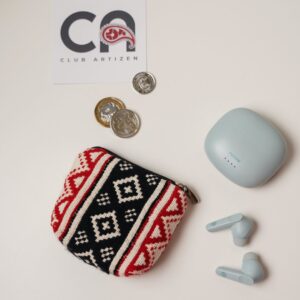

Black, red and white.
The colours of the Toda embroidery may be limited, but their repertoire is not.
The Todas, a pastoral community of about 1,500, are one of the six tribes of the Nilgiris in Tamil Nadu. Recent research suggests that they may have moved to the higher Nilgiris around 3,500 years ago, due to climate change in the peninsula!
Their craft, which they call pukhoor, was traditionally used to beautify their shawls. The motifs were inspired by nature and the mainstay of their lives, the buffalo, and flowers, after which the craft itself is named. They also had other geometric designs in their repertoire: heart shapes, triangles, Ws, and combinations of the same.
The Toda lifestyle underwent a huge change in the past 200 years or so, and the once-pastoralist community has taken to agriculture. While traditional Toda embroidery was primarily for personal use and created on their shawls called poothkuli, these days, the embroidery is used to adorn different products.
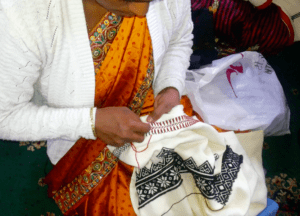
A Toda woman at work
The traditional craft of Toda embroidery was accorded the Geographic Indication (GI tag) in 2013, and is different from traditional embroidery in many ways.
For one, patterns are created by counting the threads, almost like a weave. No wonder the finished product is often mistaken for Assamese weaves! Because it is similar to a weave, the reverse is as beautiful, with no signs of hanging threads or knots.
What’s more, these Toda women, many of whom have not had any modern numeracy training, are able to produce complex geometric patterns without any ‘pattern book’ or ready reference.
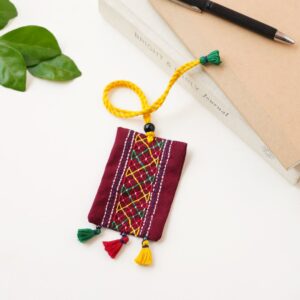
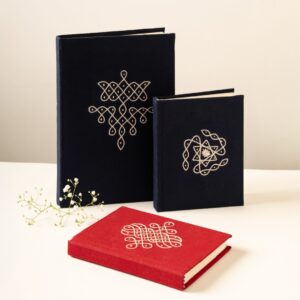
Club Artizen brings you products that preserve the techniques and motifs of the craft, while allowing everyone to enjoy the beauty of this traditional Indian craft.
Our partner works with about 200 Toda women to create beautiful products using this fascinating thread craft.