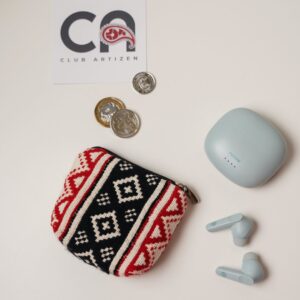
Black, red and white.
The colours of the Toda embroidery may be limited, but their repertoire is not.
The Todas, a pastoral community of about 1,500, are one of the six tribes of the Nilgiris in Tamil Nadu. Recent research suggests that they may have moved to the higher Nilgiris around 3,500 years ago, due to climate change in the peninsula!
Their craft, which they call pukhoor, was traditionally used to beautify their shawls. The motifs were inspired by nature and the mainstay of their lives, the buffalo, and flowers, after which the craft itself is named. They also had other geometric designs in their repertoire: heart shapes, triangles, Ws, and combinations of the same.
The Toda lifestyle underwent a huge change in the past 200 years or so, and the once-pastoralist community has taken to agriculture. While traditional Toda embroidery was primarily for personal use and created on their shawls called poothkuli, these days, the embroidery is used to adorn different products.
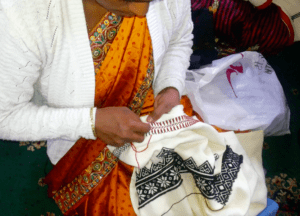
A Toda woman at work
The traditional craft of Toda embroidery was accorded the Geographic Indication (GI tag) in 2013, and is different from traditional embroidery in many ways.
For one, patterns are created by counting the threads, almost like a weave. No wonder the finished product is often mistaken for Assamese weaves! Because it is similar to a weave, the reverse is as beautiful, with no signs of hanging threads or knots.
What’s more, these Toda women, many of whom have not had any modern numeracy training, are able to produce complex geometric patterns without any ‘pattern book’ or ready reference.
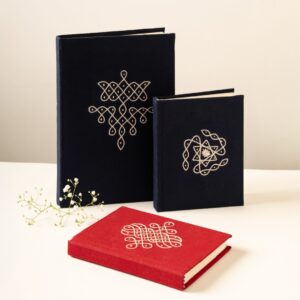
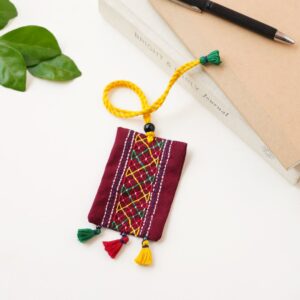
Club Artizen brings you products that preserve the techniques and motifs of the craft, while allowing everyone to enjoy the beauty of this traditional Indian craft.
Our partner works with about 200 Toda women to create beautiful products using this fascinating thread craft.
Our Embroidery Products
It took Krishna Raja Wodeyar III most of his adult life to compile a treatise on the iconography of Hindu Gods and other divine beings of South India. The treatise, called Sritattvanidhi, is most popular as the treatise that contains (and details) 122 Yogic poses in one of its texts, the Kautuka Nidhi.
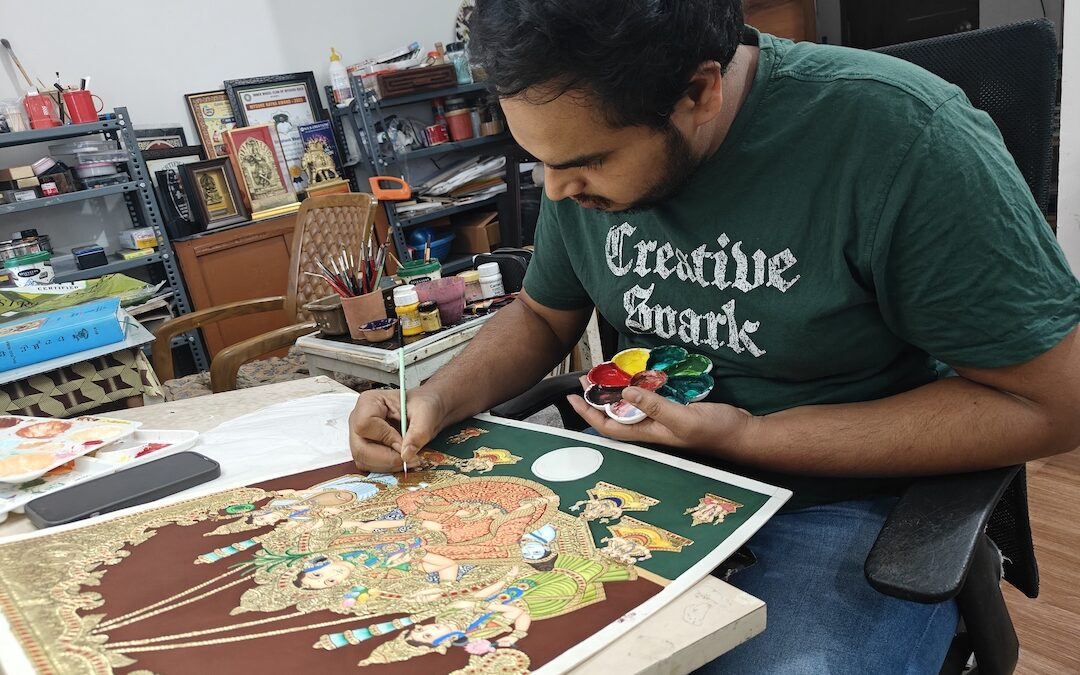
However, Mysore artist Shashank Bharadwaj is referring to the Shiva Nidhi to create his work. Mysore paintings look like Tanjore paintings, but is more intricate than its cousin. Also, the gold embossing is not as high and is almost level with the medium, which, these days, is canvas board.
“The proportion, divine weapons, and even jewellery, is specified in these texts,” says Shashank. The king, it is said, consulted hundreds of texts to collate the information regarding iconography contained within each text, much like today’s AI trawls websites!
It is this art of his native Mysore that drew Shashank to the Mysore art tradition, from his job in IT. With a family background in classical music, it was but natural that he took to this with fervour. He had a lot to learn as well.
Mysore artist at work
However, it is not all rules and proportions. Shashank creates some experimental art as well, using the techniques that Mysore paintings use. When we visit him, a book on Picasso lies on his sofa.
“There is so much in this tradition. We have to remember to do good work and carry on its illustrious history,” Shashank says.
These days, Shashank, in association with Mysore’s Oriental Research Institute, is researching Ganjifa cards, a card game that features different styles of cards and play.
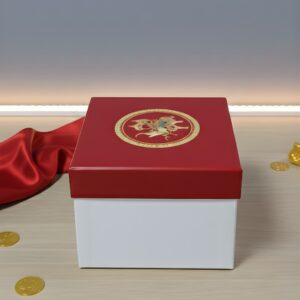
Club Artizen’s journals and boxes feature animal motifs that bring the elegance of the Mysore painting to your desks!
<hr />
<h1>Our Mysore Art Products</h1>
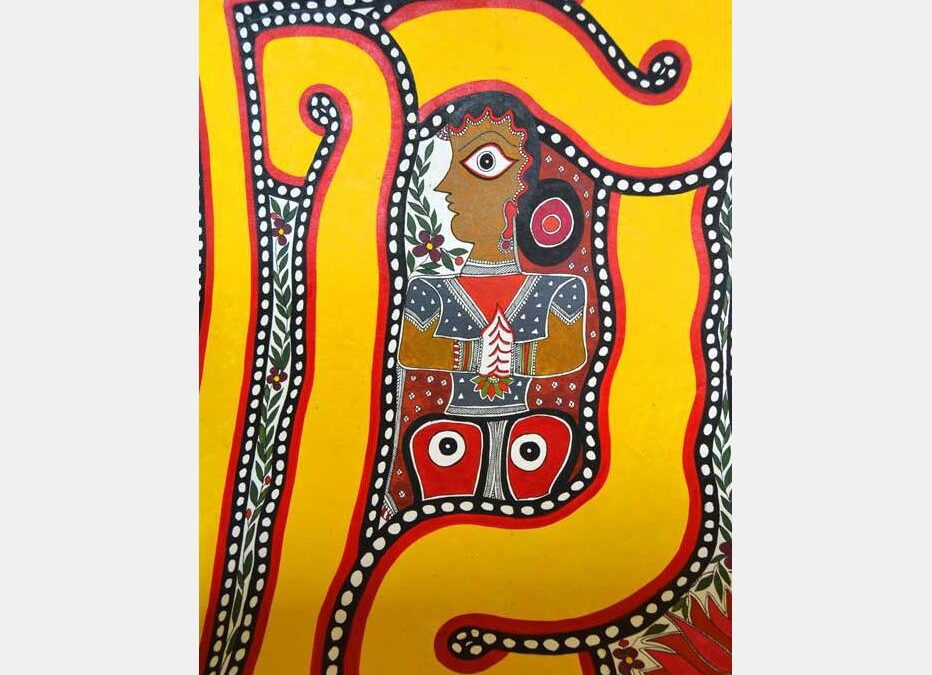
Madhubani, also called Mithila painting, originated in the Mithila region in present day Bihar. While its distinctive style and vibrant colours have garnered global attention, there are several lesser-known facts about Madhubani!
- Ancient Origins: Madhubani art can trace its roots back to ancient times. It is believed to have been practiced for over 2,500 years. The first documented reference to this art form can be found in the Ramayana. It is mentioned that King Janaka, the father of Sita, asked artists to decorate his kingdom with intricate paintings, laying the foundation for Madhubani art.
- Hidden Stories in Every Stroke: Madhubani art is not merely an aesthetic endeavour; it is a means of storytelling. Traditionally, women in the Mithila region used this art form to narrate myths, legends, and daily life through their paintings. Each element in a Madhubani painting, from the patterns to the colours, holds significance and tells a tale.
- Main Styles:
Within Madhubani art, several styles coexist.
Khodna style of Madhubani
Bharni style of Madhubani
- Bharni focuses on filling forms with bold, flat colours.
- Kachni relies on fine linework, often monochromatic.
- Godhna draws from tattoo traditions.
- Tantrik explores spiritual and esoteric themes.
- Kohbar paintings, traditionally made for weddings, symbolise fertility and prosperity.
Each style reflects a different social and cultural context.
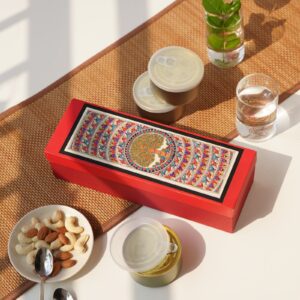
-
- Earthy Palette: Traditionally, Madhubani artists use natural pigments for their creations, even as this is fast changing. These pigments are sourced from locally available materials such as turmeric, indigo, pomegranate, and charcoal. The limited colour palette gives Madhubani art its distinct earthy and rustic charm.
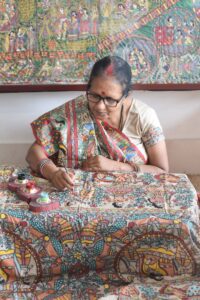
Madhubani artist Asha Jha
- Ritualistic Art: Madhubani art plays an integral role in various rituals and ceremonies in the Mithila region. It is often used to decorate homes during festivals, weddings, and other significant events. The paintings are believed to bring good luck and ward off evil spirits.
- Female Participation: While there are male Madhubani artists, the art form is primarily dominated by women. Historically, women in Mithila would pass down this traditional art from one generation to the next. This matriarchal tradition has been crucial in preserving the art form’s authenticity.
- Eco-Friendly Canvas: Traditional Madhubani paintings are created on handwoven cloth or paper made from rice straw. This eco-friendly approach not only adds to the art form’s uniqueness but also aligns with the principles of sustainability.
- UNESCO Recognition: In 2016, Madhubani art was recognized as an “Intangible Cultural Heritage of Humanity” by UNESCO. This prestigious recognition has helped raise awareness about this traditional art form and its importance in preserving cultural heritage.
Our Madhubani Products
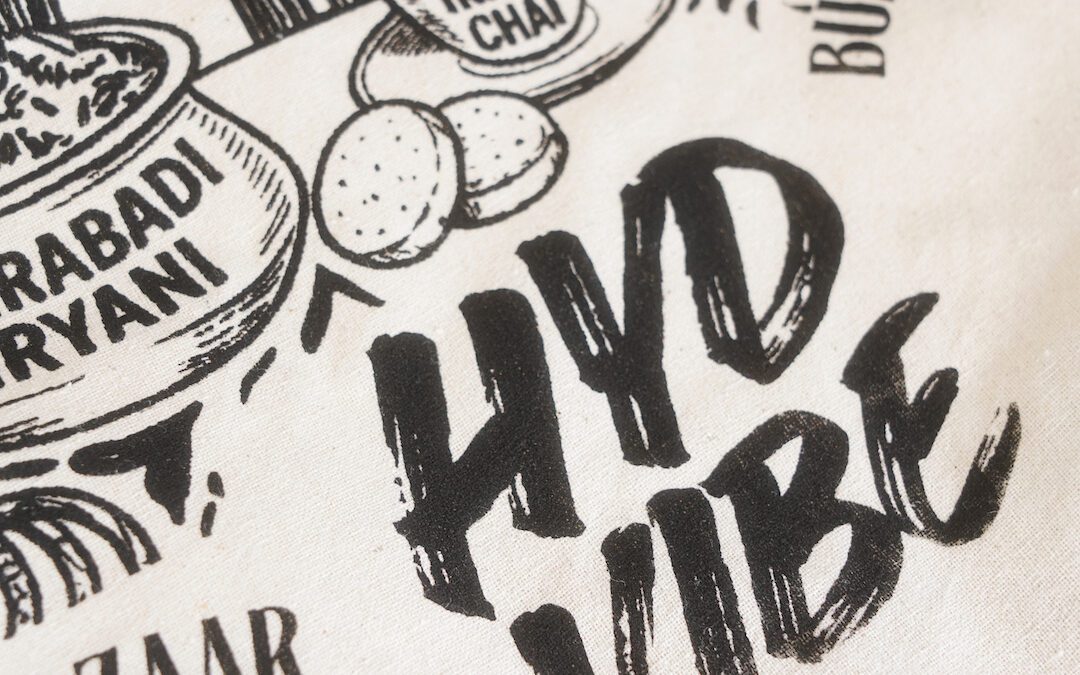
Hyderabad has its own rhythm — the aroma of biryani, the sparkle of bangles, the call of chai. The Hyderabad Vibe Tote captures this vibrant spirit through illustration, craft, and conscience.
The design features hand-drawn elements that every Hyderabadi holds dear: the Charminar, Irani chai, Hyderabadi biryani, and the colorful Chudi Bazaar. Local phrases like “Kaiku?” and “Aisaich Bolte” bring a smile to anyone who knows the city’s easygoing charm. In monochrome artwork that’s bold yet refined, this Hyderabad tote bag celebrates culture with a modern design sensibility.
Each bag is handcrafted by YellowBag — a women-led social enterprise in Madurai committed to sustainable fashion. Made from durable cotton, these eco-friendly tote bags are washable, reusable, and completely plastic-free. YellowBag trains and employs women from self-help groups, ensuring that every purchase supports livelihoods and empowers local communities.
Produced in small batches and printed using non-toxic, water-based inks, the Hyderabad Vibe Tote represents both responsible craftsmanship and contemporary Indian design. It’s a piece of art you can carry — versatile enough for errands, college, travel, or gifting.
This collaboration between Club Artizen and YellowBag brings together storytelling and sustainability. Each bag tells a tale of place, people, and purpose — transforming an everyday accessory into a reflection of India’s cultural mosaic.
The Hyderabad Vibe Tote is more than a bag; it’s a keepsake of a city known for warmth, flavor, and heritage. Carry it proudly — and carry a story stitched with care, creativity, and conscience.
It was in 2009, when her daughter studied in a Waldorf-inspired school, that psychologist Nirupama Rao understood the significance of handwork. “It was not enough to develop the mind alone—the movement of hands are so important to a person’s well-being,” says Nirupama, who picked up the craft of crochet and macrame after decades. That skill is now helping women of a Mumbai basti create a new livelihood for themselves. Through Prafulta, a Mumbai NGO that works on psychological wellness of communities, Nirupama works on a project that brings together women to create macrame products, while allowing them the space to have meaningful conversations that spark change, in a sort of “macrame pe charcha” model.“Sometimes, when we just give a lecture, the women are not too motivated.
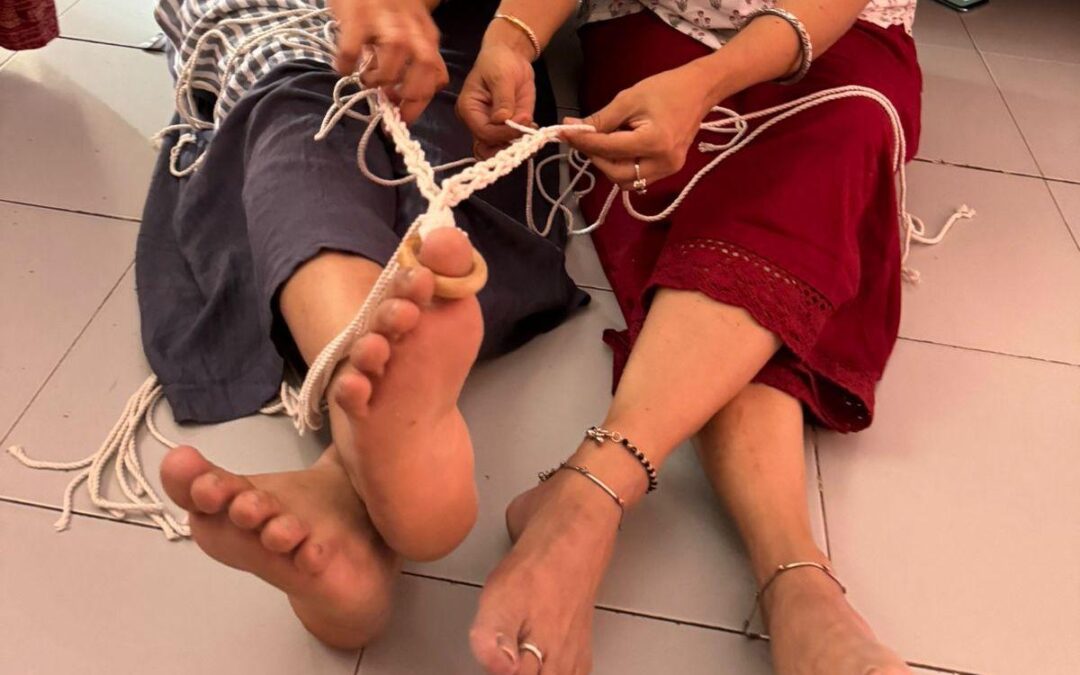
Macrame weaving in progress
As their hands are busy, they are more likely to share, and open up,” she says.The project has already trained eight women, and is now in the process of training eight more. “It’s a projection technique, as we call it in psychology,” she says. When the hands are busy, people feel freer to talk. In this project, for example, after they understand the basic knots, the women are already contributing to discussions while their hands work.”
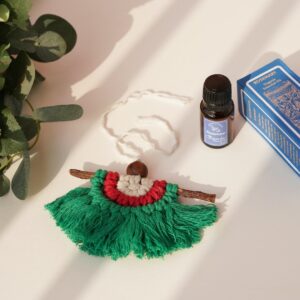
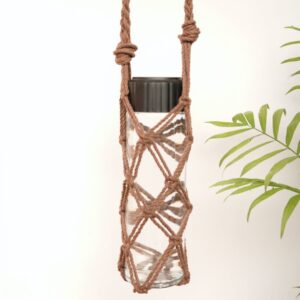
The products—ranging from bottle slings to car diffusers—are created by the women, after a brief training. Eight women have completed the training and eight more are undergoing the training. Many of the women hail from Uttar Pradesh and Bihar, and have done some embroidery or other handwork earlier.Inspiration for design comes from many places. For Club Artizen, Nirupama and the women created bottle slings and plant holders.
Nirupama envisions the project as more than just a space for casual conversations. She aims for it to be a platform where women are empowered emotionally and financially. The journey of creating beautiful macramé products becomes a pathway to self-discovery and independence for these women.
As the project continues to evolve, Nirupama remains committed to its growth and impact. Through the art of macramé, she aspires to build a community where women not only share stories and skills but also find empowerment in its truest sense.
Our Macrame Products
In Madurai, where tradition and everyday life blend quietly, the Yellow Bag Foundation reintroduced something familiar — the manjappai, or yellow cloth bag. What began as a response to plastic waste has become a thoughtful livelihood initiative, and Club Artizen is proud to partner with them.
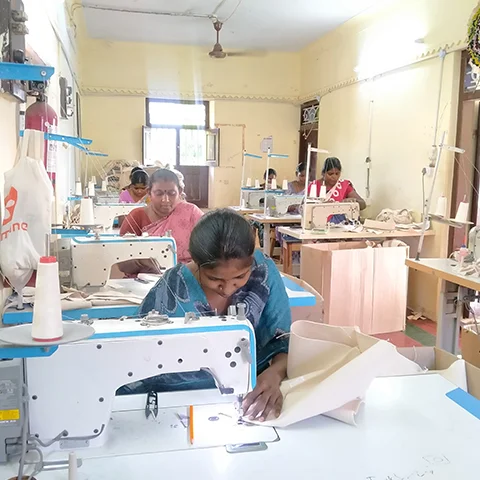
Yellow Bag works with small tailoring units, mostly women from low-income neighbourhoods, who stitch cloth bags in a range of sizes and designs. These aren’t mass-produced factory products. Each bag is made to order — for events, retail stores, wedding favours, or corporate gifting — and is customised in terms of fabric, handle, print and quantity. Their production process is decentralised, allowing women to work from tailoring centres or even from their homes, offering both income and flexibility.
What makes Yellow Bag special is not only the product, but the intent: to revive a culture of reuse, and to create dignified work using a simple, everyday object. The signature yellow is both a nod to tradition and a quiet symbol of responsibility.
For Club Artizen, this partnership reflects shared values — craftsmanship, community, and conscious making. Many of the bags and pouches we offer are handcrafted by Yellow Bag’s sewing groups in Madurai. When you hold one, you’re holding something that has passed through skilled hands, conversations, and a collective purpose.