
Craft.
When you hear this word, what image comes to mind?
A woman, knitting or embroidering, maybe?
Or perhaps a group of women, sitting around and engaging in needlework or knitting, or sewing, with lots of laughter and gossip?
Definitely not a political prisoner sending messages to her co-plotters outside a detention facility. That is what happened in the 1980s, in Chile. And the Chileans are not alone in using craft to express dissent.
Most often, we think of craft as a “benign” activity, and indeed, that was what it was meant to be, a way to advertise your homeliness and marriageability. However, that was easier thought than done. In an article by Jessica Bateman in The Establishment, Ann Rippin, a researcher at the University of Bristol in the UK, says, “There was no way of controlling what women were actually thinking about while they were stitching.”
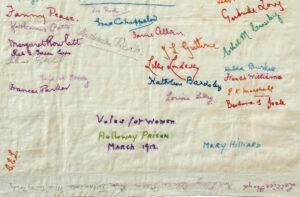
Part of the handkerchief embroidered by women detainees
From Britain’s suffrage movement, when women imprisoned in Halloway recorded their detention in prison using needlework, to India’s very own kolams and rangolis protesting the Citizenship Amendment Act, crafts and creativity have often intersected with activism to multiply their impact.
The history of craftivism, the term crafted by Betsy Greer, goes way back to France, and the tricoteuse, or the knitting woman, groups of whom would sit by the guillotine as the aristocrats would be killed during the French Revolution.
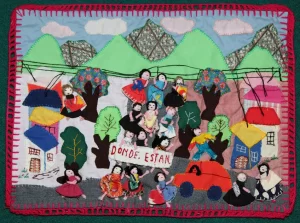
An arpirello with the iconic phrase “Donde Estan”. Courtesy: Ulster University
In Chile, for instance, mothers and wives sewed arpirellas (quilts) that depicted the horror of Pinoche’s brutal regime in the 1970s and 80s through simple imagery: scenes of domesticity with question marks instead of the men who would normally be present with the iconic phrase: Donde Estan (Where are they?). Women political prisoners would also sew arpilleras to send messages to their helpers outside. Guards would not even think of checking quilts for messages as they were considered just women’s work.
In Indonesia, artist Fitriani Dalay used knitting to yarn bomb public spaces to challenge the prevailing elitism of art and to highlight the country’s growing consumerist culture.
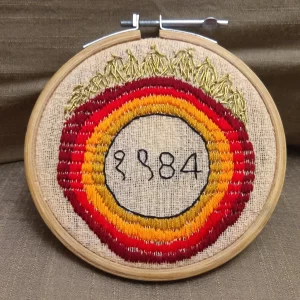
Rubina Singh’s embroidery commemorating the 1984 riots against Sikhs.
Down under, Knitting Nannas use knitting a bit differently, as a timid overlay to the atrocities they fight against.The Nannas are groups of women who make their presence felt at politicians’ offices, work sites, and rallies, as a front against fracking and other forms of destruction of the environment by sitting together and just knitting (or pursuing other everyday tasks such as shelling peas)! The contrast, of the calm knitting women and what is happening around them, reminds one of the French knitting women, bringing craftivism full circle, in a sense.
History and family craft plays a huge role in the choice of megaphone. During COVID, lawyer and activist Rubina Singh reflected on her grandmother’s art of phulkari embroidery, and began a series of embroidered art pieces that spoke about contemporary issues. Her grandmothers’ craft of Phulkari embroidery and their family history was instrumental in her choosing craft as the way to voice her opinion.
Through these, she says, she is “trying to mend our broken stories together and weave a new narrative.”
It seems like all of us are trying to do just that. These women found a way to do it: craft.
References:
https://www.mcgilldaily.com/2018/01/stitching-for-change/
https://acme-journal.org/index.php/acme/article/view/1739
https://knitting-nannas.com/about-us/what-we-do/
https://decoratingdissidence.com/2020/08/03/crafting-resistance-and-resilience/
The first product that we came across, from Seva Charitable Trust, was the gobar diya. These diyas, made from cowdung, burn out completely, and leave behind an ash residue that can be used as plant manure.
What a wonderful idea, we thought, to celebrate and move toward sustainable living, and what a lesson to human beings: to be of use, and return to the earth from where we come.
Since then, we have come to know more about Seva and their mission of saving wildlife, tigers, and Mother Earth, and the artisans they support.
Hamisha Parekh, trustee and co-founder of Seva, talks about their journey since 2015, when they started a project to recycle plastic bottles for communities living in the Sanjay Gandhi National Park area in Mumbai. SGNP, on the outskirts of Mumbai, is home to 150 species of birds and 150 species of snakes, and also houses a few leopards.
“Our idea was always driven by a need to preserve nature, and providing livelihoods helps communities who depend on the forests to live a more sustainable life, while nurturing the forests,” she says. “The idea was that they have a livelihood that does not even deplete the forest of one leaf.”
Since then, their initiatives have expanded to include several projects and partnerships, and they are on the cusp of expansion. As a wildlife trust, they are restricted by the areas they can work in, but Hamisha says that is a good thing.
After the plastic bottle recycling project, the Seva team started working with the women of the communities surrounding the park to provide other livelihood opportunities. In 2018, they started their tailoring unit in partnership with the College of Social Work, Nirmala Niketan.
When COVID hit, after a few months, mask making took on a huge effort, and Seva sold over 2,00,000 masks, marking a turning point for the artisans.
The women were not just happy that they were able to make money, but also that their work likely saved lives. Heena Dipak Parmar, supervisor at Seva, says that women from the community have increased their confidence from coming to Seva, and not only because of the income.
“it’s more than the money; it’s that they have learnt a new skill. If they work as house help, their income may be the same, but they have no way to move forward from there. Here, they are challenged, and they learn creatively, and how to solve problems.”
For instance, when an urgent order for school bags came about, the ladies figured out the optimal way to make the bags quickly: a few of them stitched the pockets and a few others, the handles, so that the bag could be assembled quicker. Often, the material and motifs are inspired by the traditional arts and crafts of India.
In parallel, Seva’s other projects on health and nutrition continues in the communities. As part of that close connection with the community, two other projects have come about, that serviced the need for the outside world to know more about theirs: the nature walk and the tribal kitchen. The nature walk is a trek along the forest, followed by a sumptuous meal at the tribal kitchen, featuring the local menu.
Plans are on to expand their programs to other states, including Karnataka and Tamil Nadu.
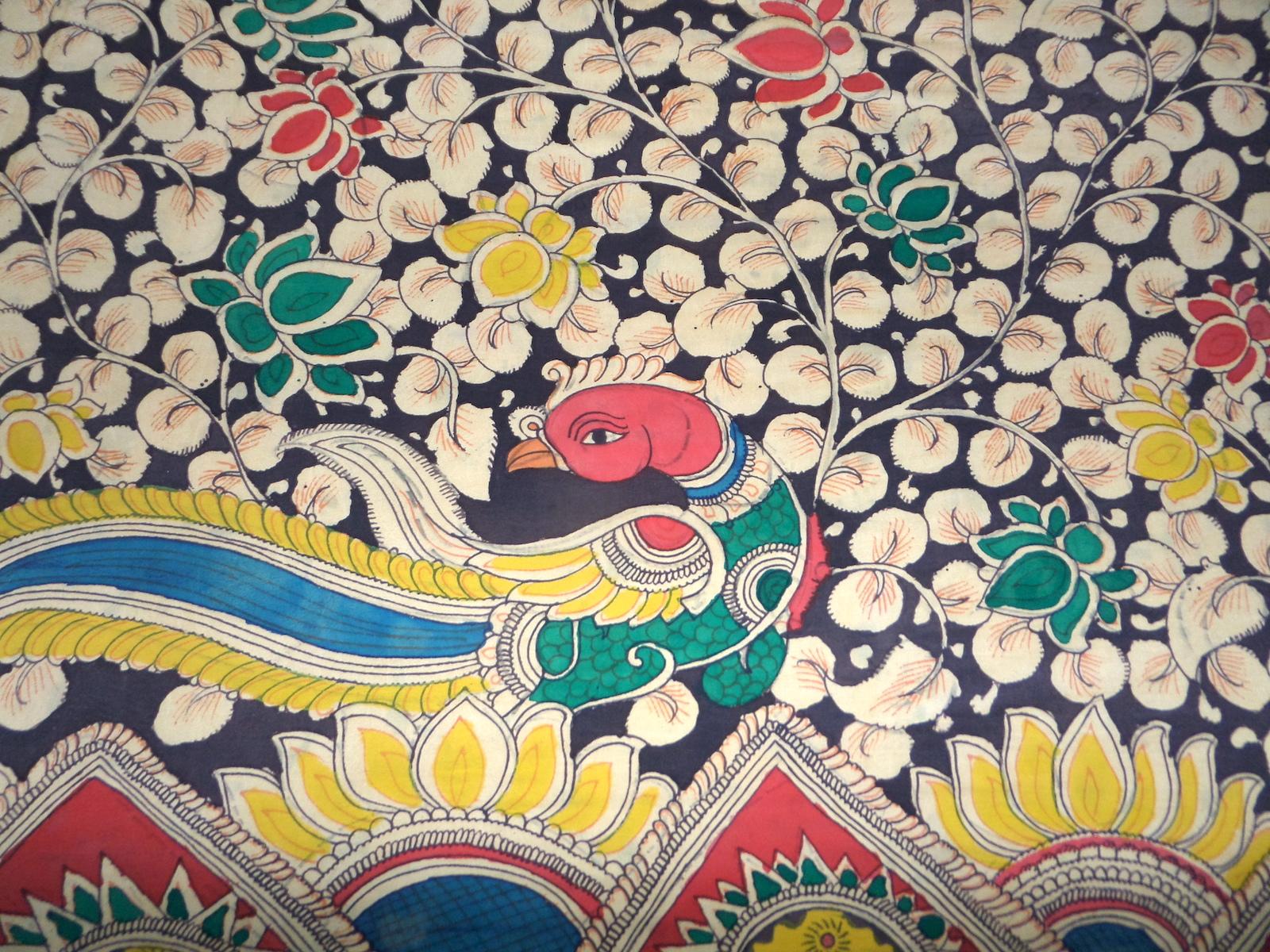
If you live in India, you could not have missed hearing the word ‘kalamkari.’ Chances are, you own something made of kalamkari fabric—a piece of clothing, perhaps, or a home décor item.
Kalamkari is an ancient art—from “kalam” i.e. pen, and “qari”, i.e. craftsmanship. We even know this.
However, there is much more to Kalamkari than just these facts. The art form has a rich history that spans centuries, a lot of it very interesting!
For instance, did you know that the craft, in its own way, threatened the economy of three European countries? Read on to know more.
1. You might know of two types of kalamkari, both in Andhra: the Machilipatnam style and the Srikalahasti style. There is, however, a third style that even has a GI tag. It’s the Karuppur Kalamkari style of Tamil Nadu that is now primarily used to adorn temple chariots and doorways.
Karuppur Kalamkari @TheIndianSareeJournal
2. The Srikalahasti style is still mostly hand painted, but the Machilipatnam style has moved to block printing of designs. This may have to do with the fact that Machilipatnam is a port town and was known to be the export point for Kalamkari textiles.
3. The Srikalahasti style features a lot of Hindu iconography, while the Machilipatnam style, patronized by the Golconda rulers, features more themes from nature: leaves, flowers, and the like.
European ‘chintz’, inspired by Kalamkari.
4. Kalamkari and its derivative, “Chintz,” were the reasons for a law to outlaw imports of cotton to England. A kalamkari-inspired cloth, called chintz (meaning ‘spotted’), was exported to England and France by the East India Company, creating huge losses for English millowners. This was a major issue in the 1680s to 1740s in Europe. Imported cotton was eventually banned in England, France, and Spain. This led to the mechanization of mills, contributing largely to the Industrial Revolution.
5. While the craft of kalamkari is still practised today, it’s not as widespread as it used to be. The actual process of making Kalamkari involves 23 steps; there are 17 steps involved in the printing process alone! This laborious technique means that only a few select artisans are willing and able to perform this task as it was done in the past.
6. The Buddha motif has become very popular in recent years. While there are references to kalamkari in ancient Buddhist texts, this recent design of the Kalamkari Buddha may have to do with demands of the market.
7. The United States, Italy and Nepal are the leading importers of Kalamkari products from India, with the United States having the lion’s share at around 85%.
It’s mind boggling to think that every single art form has a history that spans generations, moulding it to its current state. It is our responsibility to know more and patronize our Indian art forms whenever possible.
Check out our website for these kalamkari-inspired products!
Artists were cameramen of those days, says Sachin Kothari, of Fine Arts School, Udaipur, of Mewar Art. “They accompanied the king wherever he went, and would instantly paint scenes from these outings.”
Mewar art, a popular miniature art form from the 16th and 17th centuries, characterized by bright colours and mostly religious forms in the earlier years, included snippets of royal life from around the 18th century.
Sachin Kothari at work
It is this art form that Kothari, 62, is working hard to preserve. He works with youth from tribal and rural regions around Udaipur, and helps them get a footing in this traditional art. It is not an easy task to get trained, he says. His program runs for five years, and students are given a stipend during this time.
So far, he has trained over 50 students, and unfortunately, only 10 or so are still practicing the art. “That’s better than nothing,” says Kothari.
One of them is Mohanlal Negwal, 45, who came to the school as a student nearly 12 years ago. Now, he works with Kothari, and creates the miniature paintings the school is famous for. Other artists like Surender are also part of Kothari’s artist group.
Mohan, a farmer, visited Udaipur often, and during one of these visits, walked into the school. He was then looking for some additional income, and joined the course. After three years, he started working on projects with Kothari, and now, he says he would not do anything else.
“It chooses you, art. Just like the halwai puts in ghee, sugar, and badam, and takes his time to make the sweet, art takes time, but the end result is amazing.”
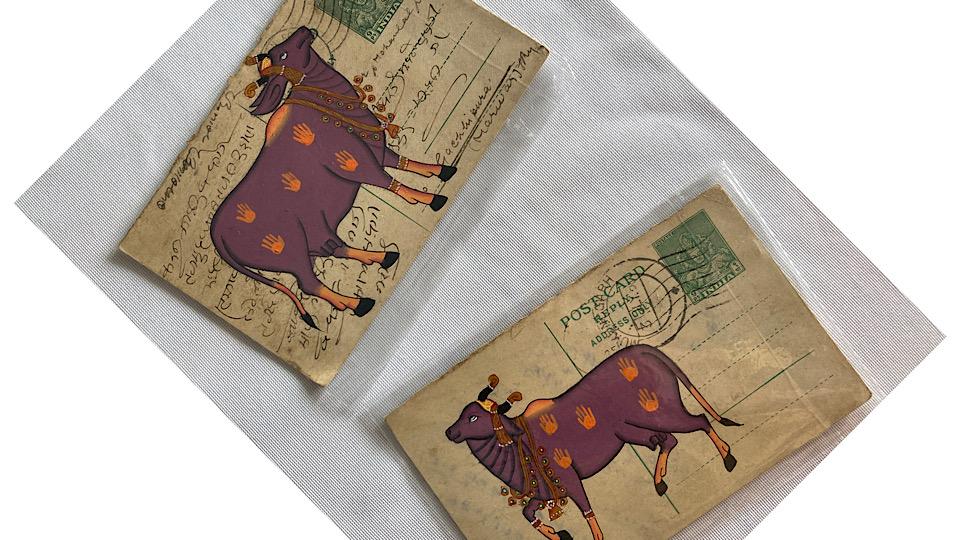
Sample Mewar art on antique postcards
As people move toward modern themes and newer pastures, Kothari sticks to traditional themes, only changing the medium. Earlier the paintings were done on ivory and on paper, and many of Kothari’s work are on silk.
One of the most eclectic pieces of work his school has brought out is the Mewari and Pichwai artwork made on vintage postcards.
“The paper is very good to work on—it is acid-free,” says Kothari. Only on asking him more does he tell us the process: his team collects postcards and old accounts books from older parts of Udaipur—the palace and the wholesale market, where these things are regularly disposed of. The medium is prepped and the work then begins.
Exquisite detailing
Sample miniature art in progress
It is not as easy as just dipping the brush in the paint. The brushes are handmade—from squirrel hair—and the pigments too—from different coloured agates.
The process of painting can take a few days, depending on the skill of the artist.
Mohan weighs in on why there aren’t many takers for this art. “Patience. That is what is missing today. People want to take the lift to the 10th floor, not take the stairs, which is what art is,” he says.
It’s not just the artists, though. Kothari rues the fact that miniature painting does not get its due in India: “People ask why the price is high for such a small piece!” A lot of his clientele are from other countries, but he wishes more people in India appreciated their own history.
“It will take a lot of education to get people to appreciate traditional arts,” he says.
But try he will. With the help of artists like Mohan and Surender, it just may be possible.
Palm Leaves Cluster, Pulicat
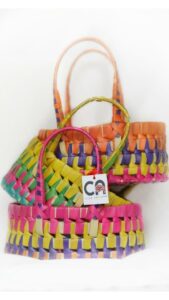
In Pulicat, the palm tree is a constant presence–be it in the crafts of the region, or just standing tall, protecting the Pulicat lagoon from ecological erosion.
Pulicat, or Pazhaverkadu, an erstwhile Dutch settlement about 60 kms to the north of Chennai, is named after the saltwater lagoon that is to the north of the town. It’s primarily a fishing town, and the introduction of palm leaf crafts has revitalized the economy of the place. Palm leaf crafts are naturally sustainable products and are great sustainable gifting options. AARDE is an organization working for the promotion and conservation of natural and built-heritage of Pulicat Lagoon since 2007 and has been instrumental in promoting palm leaf products, with an eye on conservation. This has been a unique feature of the Pulicat weavers, who do not take more orders than the ecosystem can take. In contrast, a few other areas where palm leaf products are made in Tamil Nadu, including Manapad, find it difficult to balance ecology and economy.
The majority of the weavers of Pulicat are women. While the men harvest the leaves, the women cut them into sheaths, dry and dye them, and weave them into contemporary products.
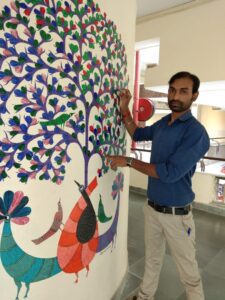
Lilesh has a master’s degree in social work. He is a farmer too. However, the identity he wishes to be known by, is that of a Gond artist.
Speaking from his home near Dindori, Madhya Pradesh, he talks about his introduction to the art. It’s no different from most of the other artisans I’ve spoken with. “My father was a Gond artist, and seeing him, my brother and I picked it up.” What seems like an automatic initiation actually involves years of apprenticeship, before the artist can showcase their solo art. Lilesh’s brother, Nikki, is an accomplished artist in his own right, and has sold many paintings over the years.
When I speak with him, it is sowing season for chana, and that is what Lilesh is doing. He tells me about the families in his village who have given up Gond. It’s a far cry from the heady days of the popularity of artists like Jangarh Singh Shyam, who was invited to create Gond murals for the Madhya Pradesh Legislative Assembly.
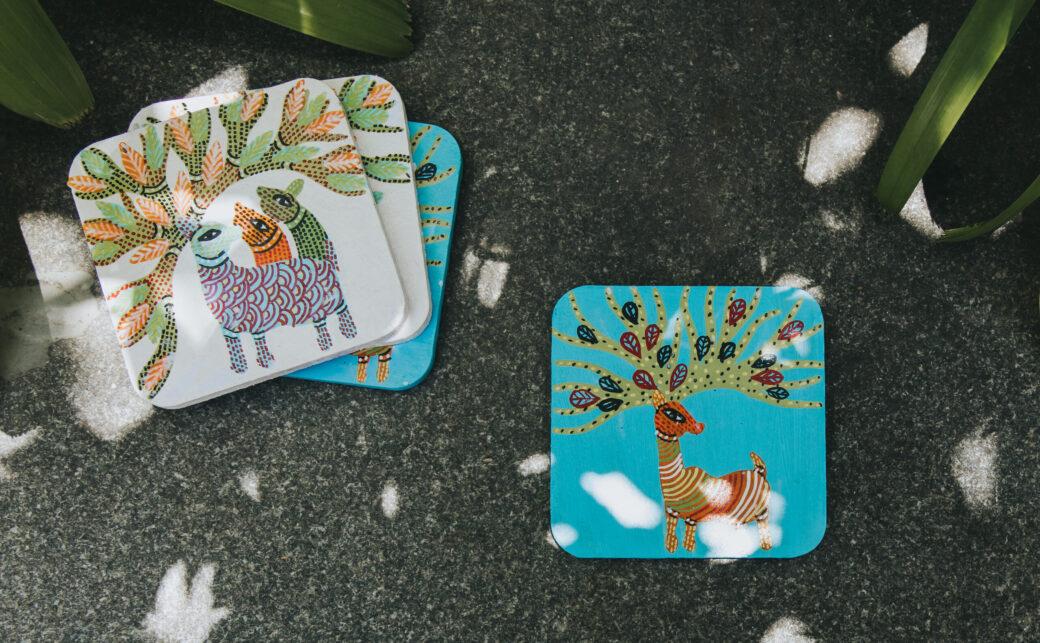
However, the brothers want to see the art in every household and undertake any project: be it murals, or paintings, or coasters such as these.
“There is limited scope in paintings, and only a few people get to enjoy it. In murals, or small art pieces, more and more people enjoy the art form,” says Lilesh.
Also by Artist Lilesh



 What a wonderful idea, we thought, to celebrate and move toward sustainable living, and what a lesson to human beings: to be of use, and return to the earth from where we come.



 Speaking from his home near Dindori, Madhya Pradesh, he talks about his introduction to the art. It’s no different from most of the other artisans I’ve spoken with. “My father was a Gond artist, and seeing him, my brother and I picked it up.” What seems like an automatic initiation actually involves years of apprenticeship, before the artist can showcase their solo art. Lilesh’s brother, Nikki, is an accomplished artist in his own right, and has sold many paintings over the years.
When I speak with him, it is sowing season for chana, and that is what Lilesh is doing. He tells me about the families in his village who have given up Gond. It’s a far cry from the heady days of the popularity of artists like Jangarh Singh Shyam, who was invited to create Gond murals for the Madhya Pradesh Legislative Assembly.
Speaking from his home near Dindori, Madhya Pradesh, he talks about his introduction to the art. It’s no different from most of the other artisans I’ve spoken with. “My father was a Gond artist, and seeing him, my brother and I picked it up.” What seems like an automatic initiation actually involves years of apprenticeship, before the artist can showcase their solo art. Lilesh’s brother, Nikki, is an accomplished artist in his own right, and has sold many paintings over the years.
When I speak with him, it is sowing season for chana, and that is what Lilesh is doing. He tells me about the families in his village who have given up Gond. It’s a far cry from the heady days of the popularity of artists like Jangarh Singh Shyam, who was invited to create Gond murals for the Madhya Pradesh Legislative Assembly.
 However, the brothers want to see the art in every household and undertake any project: be it murals, or paintings, or coasters such as