Craft.
When you hear this word, what image comes to mind?
A woman, knitting or embroidering, maybe?
Or perhaps a group of women, sitting around and engaging in needlework or knitting, or sewing, with lots of laughter and gossip?
Definitely not a political prisoner sending messages to her co-plotters outside a detention facility. That is what happened in the 1980s, in Chile. And the Chileans are not alone in using craft to express dissent.
Most often, we think of craft as a “benign” activity, and indeed, that was what it was meant to be, a way to advertise your homeliness and marriageability. However, that was easier thought than done. In an article by Jessica Bateman in The Establishment, Ann Rippin, a researcher at the University of Bristol in the UK, says, “There was no way of controlling what women were actually thinking about while they were stitching.”
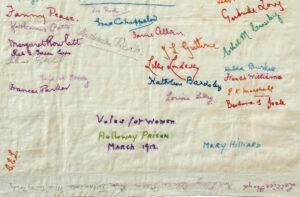
Part of the handkerchief embroidered by women detainees
From Britain’s suffrage movement, when women imprisoned in Halloway recorded their detention in prison using needlework, to India’s very own kolams and rangolis protesting the Citizenship Amendment Act, crafts and creativity have often intersected with activism to multiply their impact.
The history of craftivism, the term crafted by Betsy Greer, goes way back to France, and the tricoteuse, or the knitting woman, groups of whom would sit by the guillotine as the aristocrats would be killed during the French Revolution.
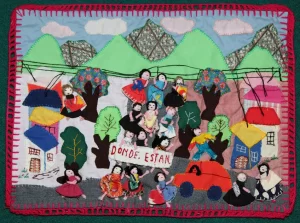
An arpirello with the iconic phrase “Donde Estan”. Courtesy: Ulster University
In Chile, for instance, mothers and wives sewed arpirellas (quilts) that depicted the horror of Pinoche’s brutal regime in the 1970s and 80s through simple imagery: scenes of domesticity with question marks instead of the men who would normally be present with the iconic phrase: Donde Estan (Where are they?). Women political prisoners would also sew arpilleras to send messages to their helpers outside. Guards would not even think of checking quilts for messages as they were considered just women’s work.
In Indonesia, artist Fitriani Dalay used knitting to yarn bomb public spaces to challenge the prevailing elitism of art and to highlight the country’s growing consumerist culture.
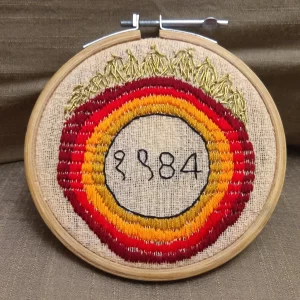
Rubina Singh’s embroidery commemorating the 1984 riots against Sikhs.
Down under, Knitting Nannas use knitting a bit differently, as a timid overlay to the atrocities they fight against.The Nannas are groups of women who make their presence felt at politicians’ offices, work sites, and rallies, as a front against fracking and other forms of destruction of the environment by sitting together and just knitting (or pursuing other everyday tasks such as shelling peas)! The contrast, of the calm knitting women and what is happening around them, reminds one of the French knitting women, bringing craftivism full circle, in a sense.
History and family craft plays a huge role in the choice of megaphone. During COVID, lawyer and activist Rubina Singh reflected on her grandmother’s art of phulkari embroidery, and began a series of embroidered art pieces that spoke about contemporary issues. Her grandmothers’ craft of Phulkari embroidery and their family history was instrumental in her choosing craft as the way to voice her opinion.
Through these, she says, she is “trying to mend our broken stories together and weave a new narrative.”
It seems like all of us are trying to do just that. These women found a way to do it: craft.
References:
https://www.mcgilldaily.com/2018/01/stitching-for-change/
https://acme-journal.org/index.php/acme/article/view/1739
https://knitting-nannas.com/about-us/what-we-do/
https://decoratingdissidence.com/2020/08/03/crafting-resistance-and-resilience/
Last week, Club Artizen was at the Gifts and Stationery Expo in Hyderabad.
We were thrilled to note the interest in our work in sustainable and handmade products, and that companies were examining the impact of all their actions, including gifting, on the planet.
On the sidelines, though, we noticed that a lot of waste was generated. There were lunch packets, packaging, signages, and a whole lot of other things that were destined for the trash.
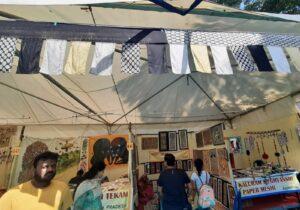
Cloth buntings at a crafts mela
We got to thinking about the fact that this was a wide problem, right from birthdays to conferences, and came up with a few to minimize waste at events.
- Discounts for stalls that promote sustainable living. Think cotton buntings, sustainable packaging, and the like. We saw this at a recent crafts mela and were very impressed!
- Serving food in sustainable material. Today, in India, plates and cutlery made of wood and areca nut are everywhere. There is no reason not to go sustainable. India is way ahead of the curve when it comes to this. In fact, there are companies that make edible cutlery as well!
- E-invites. Again, the pandemic has thrown out the idea of personal invitations being all-important. Most people are okay with a personalized e-invite.
- Sustainable gifts and mementos. Gifting a handmade product made by a local artisan and/or using a traditional local craft or material can go a long way in promoting these arts and crafts. Now, this is something Club Artizen can directly help with.
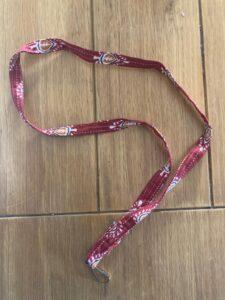
Cloth lanyard for events
- Checking for options with all vendors. Right from lanyards and ID tags, to flexes and decorations, consider sustainable options. This industry is booming and chances are, you can find sustainable options for most products.
- Going slow. It’s best to go step by step on this, if it seems too overwhelming. Start with a few items and slowly add each piece.
- Waste disposal. After the event, it’s important that the waste is disposed of in a responsible way that encourages recycling. Check the facilities available for the same. If not, there are many NGOs who might be able recycle the materials to handcraft products out of them.
Going sustainable may seem daunting, but little steps will go a long way.
Contact us for a free consult and ideas on making your event more sustainable!
Ah, denim. It’s the ultimate fabric that can be worn almost every day, from work to the weekend.
When you think of denim, you probably imagine jeans. But did you know that this fabric is also used in clothing, car upholstery, and even other products? The blue jean was originally created as workwear that would hold up through everyday wear and tear.
Denim recycling can help reduce waste while supporting local artisans who are turning old clothes into new ones! Many organizations also use denim in their traditional fabric-based crafts as well.
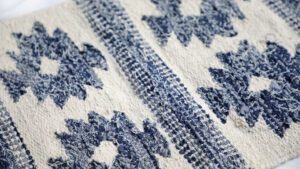
We worked with Sabtera, an organization working to bring back the traditional Punja Dhurrie craft, to create these mats, which are made using white cotton yarn and old denim yarn. We at Club Artizen also collect old clothes, including denim, and donate them to India Wasted, an organization that works to ensure zero waste.
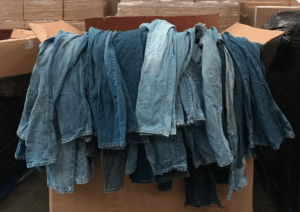
Sixteen-year-old Nirvaan Somany came up with a brilliant idea to recycle old jeans: to stitch together sleeping bags for the homeless.
If you are the DIY type, denim is so versatile that it can be used in many recycling projects as well. Here are a few ideas to take that step toward sustainable living!
- Pillow: Turn a pair of jeans into a comfy pillow. All you need are scissors, fabric glue, and an old pair of jeans. Here’s a video to teach you just that!
Jeans to be recycled. Pic courtesy Nirvaan Somany
- Use recycled denim fabric to create collars, toys and leads for dogs and other pets—perfectly sized to fit any animal without ever having to be adjusted! What’s more, they look super cool! Check out how to make denim toys for dogs here.
Now, you know that recycling your denim is easy. You can donate your old jeans to someone in need, or you can turn them into something new and useful for yourself. The best part about all of these options? They’re sustainable! Go ahead and make some space in your closet – it’s time to get rid of those old jeans.
So, next time you’re getting rid of that old pair of jeans, think about giving them a second life. It’s easy to do and great for the environment!
(Featured image by Roberto Sorin on Unsplash )
Already ditched your new year resolutions and feeling awful? Fear not, for a few weeks from now to April, there will be many occasions to wish each other a happy new year and to make those resolutions over and over again until you finally start keeping them!
Yes, I’m talking about the slew of harvest festivals from different regions of India that start in January and end in April! All over India, we honour farmers and the produce they grow, and pray for a healthy new season.
However one common practice that holds zero relevance today and is downright dangerous to our health is the burning of discarded items. Burning trash is not only illegal in India but also contributes up to 26% of carbon emissions in some Indian cities.
Be it Lohri, Makar Sankranti or Pongal, bonfires are built to burn discarded items like paper, clothes, and even rubber and plastics! This hearkens back to the practice of clearing up one’s home and removing negativity by getting rid of unused and broken items lying around the home.
Bhogi bonfire
Early mornings on these festive days are filled with the acrid smell of plastics and rubber burning. Even bonfires built with only leaves and wood are dangerous to our health as they release particulates which embed in our lungs. Leaf smoke contains benzo-pyrene which is a factor in lung cancer caused by cigarettes. On these days, a thick smog covers the city leading to itchy eyes, sore throats, and serious repercussions for those prone to respiratory illnesses.
Yes, it is upsetting to see the fun rituals of our childhood fade away. There is something convivial and enjoyable about building and sitting around a bonfire. However, in densely packed cities where every street has at least a couple of fires on festive days, the impact on our respiratory systems is huge. So why not evolve with the times and find better ways to celebrate?
Club Artizen has partnered with India Wasted to collect all kinds of waste that can be recycled: e-waste, clothes, empty juice cartons, plastic covers, etc. Please contact us to know more.
Here’s what else you can do:
- Organise your discards in boxes – appliances, cables, clothes.
- Let everyone know you have things to give away. For example, I have informed all my friends and family to check with me first before they buy a cable or an adaptor.
- Let’s get back into the repair culture. Darn tears, sew buttons, take in or let out seams for clothes, and find local repair shops for appliances.
- Every city has vendors that will buy your discards. Dedicate a space for your neatly segregated discards and hand them over to a recycler every few months.
Let’s do our bit to ensure the beautiful invigorating morning mist doesn’t become a thick gray toxic smog.
Image credit: Avinashpothineni, CC BY-SA 4.0 <https://creativecommons.org/licenses/by-sa/4.0>, via Wikimedia Commons
Featured image: Photo by Suraj Kardile on Unsplash
Last week, I was at my father’s house. As it happens, I usually discover something or the other that makes me go “aaawww”, usually from some part of my childhood.
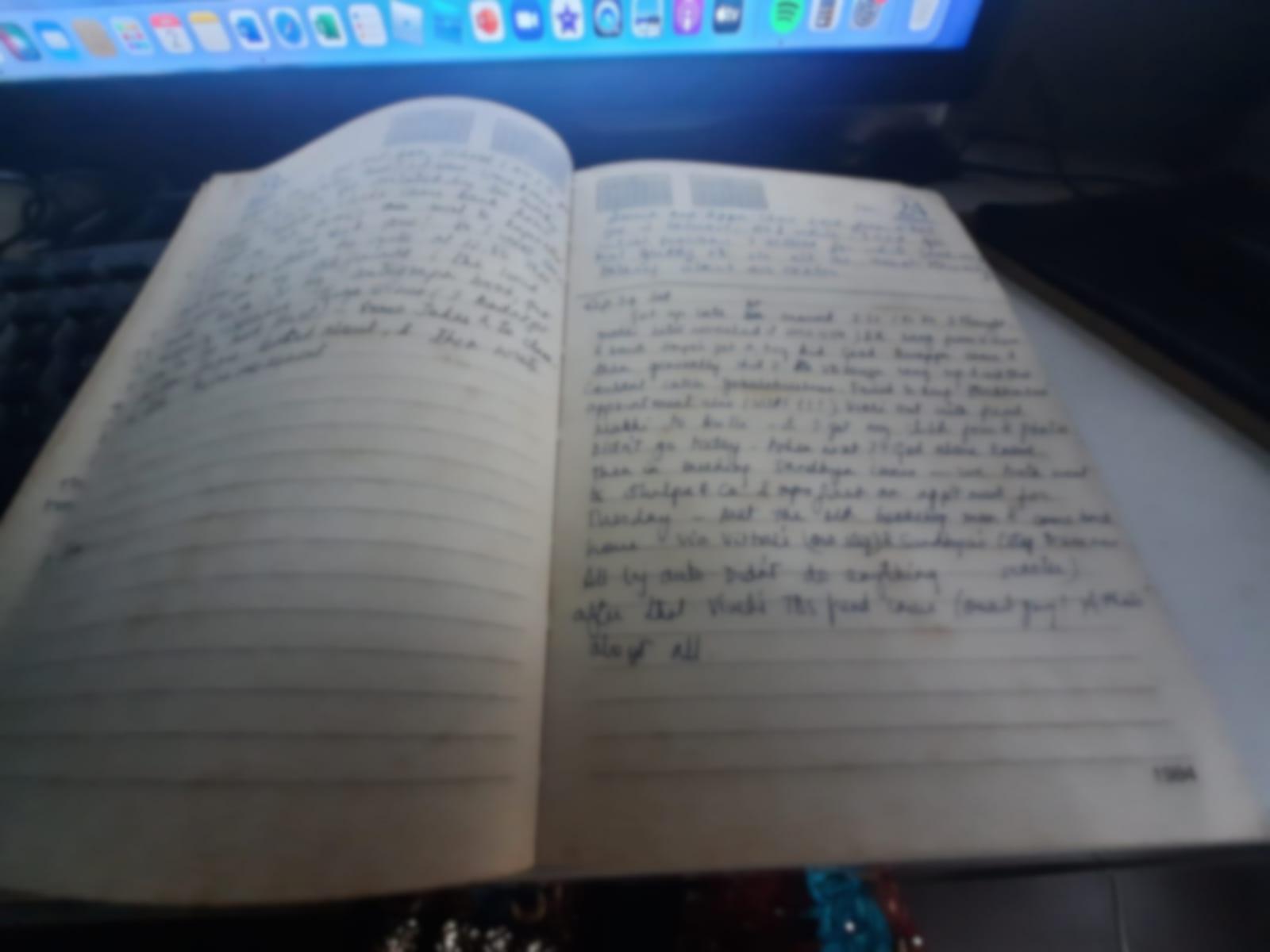
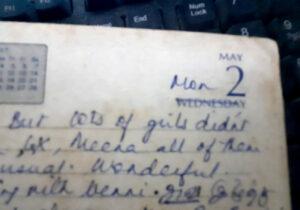
This time, it was something that led me down a road of reflection: a diary from 1994! It’s only recently that a journal and a diary are differentiated—for the longest time, we fought over the few diaries that Appa would get from his office and other acquaintances, to write our hearts out.
1994 was when I wrote my Class 12 exams and the first time I made money for writing, as a reporter for Mylapore Times! There were stories of weddings, new friends and old, the new job, disappointments and crises.
A serendipitous discovery of an old diary/journal!
Through it all, I realized two things:
- I was not as eloquent as I thought I was … and
- Reflection is critical to evolving
I also realized that the traditional diary, with dates printed on them made no sense, because some days, I had lots to say, so much that it overflowed into two or three “dates” and there were times when I had nothing to say!
Had to change the day of each of the dates, because this was an old diary!
Even if the specifics of the happenings had long been forgotten, reading the journal was a great experience. It made me see how far I had come not just in understanding the world around me, but also in writing.
It was an amazing trip down memory lane, and buoyed by this experience, I started a journal for 2023!
Hope you have an amazing year, and if you’re looking for a journal that’s gentle on the earth, look up our selection of handmade paper journals here— they’re at 10% off for a limited time! It also helps communities in need, and many of them feature traditional Indian handicrafts, so there’s a double positive right there!
Did you know that most handmade paper is made from cotton cloth waste from factories? I did not know that, before the Club Artizen journey!