When you’re cooking, it’s easy to forget about the small things that add up to big waste. But when you think about how much food ends up in your trash can every week—and how much of that food could have been eaten or composted instead—it becomes clear that reducing your kitchen waste is a lot easier than you might think.
In fact, by swapping out plastic wrap for reusable bags and learning new ways to use spices and herbs instead of buying them packaged at the store (or making them yourself), you’ll save enough money on groceries each month that it’s almost like getting paid back for all the time spent prepping meals before eating them! So let’s get started:
Swap out your plastic wrap
Use beeswax wrap or reusable parchment paper. Beeswax is thicker, so it can withstand heat better than plastic wrap and won’t release harmful chemicals into your food. If you’re interested in making sure that your food stays fresh longer (even if it’s not being heated), try using those steel dabbas for leftovers instead of plastic bags!
Use cloth napkins instead of paper ones—both are better for the environment because they don’t need to be disposed of after use and take up less space in landfills than paper products do; plus they’re more affordable too!
Buy food in bulk and repackage into reusable containers: This way you won’t have to waste any plastic bags—and even better yet: You’ll save money too!
Go reusable
- Buy reusable containers
- Use cloth napkins instead of paper napkins
- Use reusable grocery bags
- Use reusable water bottles
Don’t buy bottled water
If you’re buying bottled water, consider the cost of your purchase. A one-litre bottle costs anywhere from Rs. 20-30, and the bottle ends up in a landfill, more often than not. So if you’re going to buy bottled water anyway, it makes sense to fill up reusable containers with cheaper and more environmentally friendly alternatives like filtered or spring water instead.
If you do decide to buy bottles instead of cans or buckets, make sure they are BPA-free (Bisphenol A is an endocrine disruptor) and recyclable; this will help reduce landfill waste in addition to improving public health through improved sanitation practices.
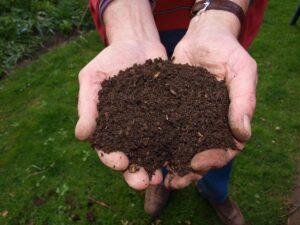
Compost your food scraps
Image by Joke vander Leij from Pixabay
Food scraps are the most common type of garbage, accounting for about half of all landfill waste. By composting your food scraps, you can reduce landfill waste and improve soil quality.
There are many different ways to compost: you can use a backyard bin or get creative with worms in your kitchen! check if your apartment complex has a community composting program, or initiate one yourself!
When you do your Diwali or Pongal cleaning, use the 6-month rule.
If you haven’t used something in six months, it’s unlikely you need it. Consider donating any kitchen items that no longer serve your needs. You can also sell them to your local recycling centre, or try repurposing them.
Reducing your kitchen waste is easy to do with a few simple swaps.
Reducing your kitchen waste is easy to do with a few simple swaps. Here’s how:
- Make a list of things that you can do to reduce your kitchen waste. This will help you get started, and then it will become easier over time!
- Don’t buy things you don’t need to buy. For example, if there is an item sitting on the shelf in front of you thinking it might be useful one day, think about why it hasn’t been used yet—maybe it’s because no one has asked for it or maybe its usefulness hasn’t come up yet? Either way, try not buying something unless there’s an immediate need for it!
- If there isn’t anything else going on at home right now but still want something better than what was already bought before…think twice next time before buying anything new (even if just once). The last thing anyone wants after spending money on groceries or visiting stores during their busy days are empty cabinets full of food items gone bad due mostly due lack of proper storage conditions for keeping them fresh until needed again later down line.
If you’re ready to take the next step in reducing your kitchen waste, start by swapping out plastic wrap for reusable produce bags. Then get creative with how you reduce food waste — try composting or donating your scraps to a local farm. And finally, don’t forget that the more we all care about this issue, the better! Your efforts will make a difference and ultimately save both money and resources for future generations.
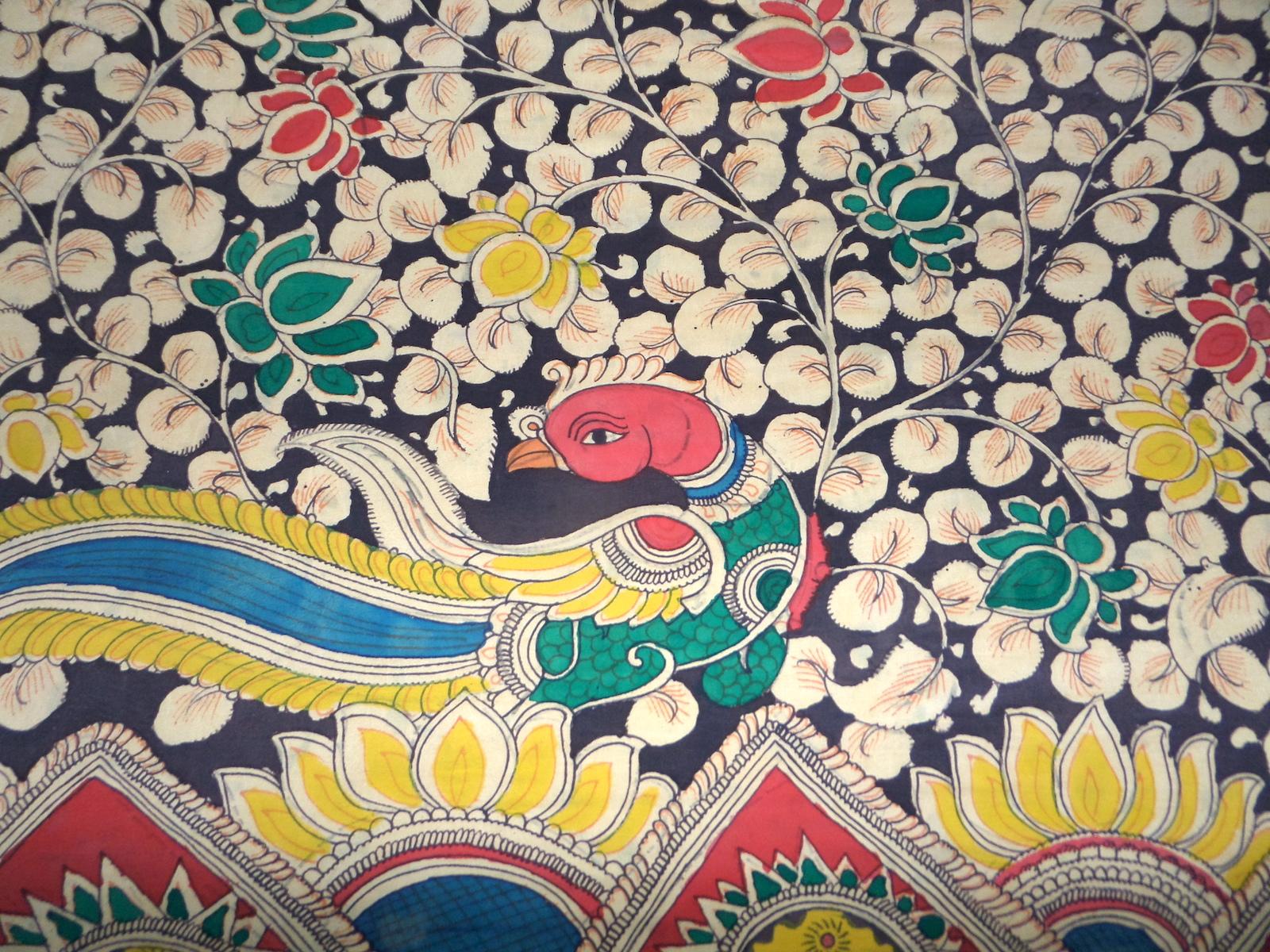
If you live in India, you could not have missed hearing the word ‘kalamkari.’ Chances are, you own something made of kalamkari fabric—a piece of clothing, perhaps, or a home décor item.
Kalamkari is an ancient art—from “kalam” i.e. pen, and “qari”, i.e. craftsmanship. We even know this.
However, there is much more to Kalamkari than just these facts. The art form has a rich history that spans centuries, a lot of it very interesting!
For instance, did you know that the craft, in its own way, threatened the economy of three European countries? Read on to know more.
1. You might know of two types of kalamkari, both in Andhra: the Machilipatnam style and the Srikalahasti style. There is, however, a third style that even has a GI tag. It’s the Karuppur Kalamkari style of Tamil Nadu that is now primarily used to adorn temple chariots and doorways.
Karuppur Kalamkari @TheIndianSareeJournal
2. The Srikalahasti style is still mostly hand painted, but the Machilipatnam style has moved to block printing of designs. This may have to do with the fact that Machilipatnam is a port town and was known to be the export point for Kalamkari textiles.
3. The Srikalahasti style features a lot of Hindu iconography, while the Machilipatnam style, patronized by the Golconda rulers, features more themes from nature: leaves, flowers, and the like.
European ‘chintz’, inspired by Kalamkari.
4. Kalamkari and its derivative, “Chintz,” were the reasons for a law to outlaw imports of cotton to England. A kalamkari-inspired cloth, called chintz (meaning ‘spotted’), was exported to England and France by the East India Company, creating huge losses for English millowners. This was a major issue in the 1680s to 1740s in Europe. Imported cotton was eventually banned in England, France, and Spain. This led to the mechanization of mills, contributing largely to the Industrial Revolution.
5. While the craft of kalamkari is still practised today, it’s not as widespread as it used to be. The actual process of making Kalamkari involves 23 steps; there are 17 steps involved in the printing process alone! This laborious technique means that only a few select artisans are willing and able to perform this task as it was done in the past.
6. The Buddha motif has become very popular in recent years. While there are references to kalamkari in ancient Buddhist texts, this recent design of the Kalamkari Buddha may have to do with demands of the market.
7. The United States, Italy and Nepal are the leading importers of Kalamkari products from India, with the United States having the lion’s share at around 85%.
It’s mind boggling to think that every single art form has a history that spans generations, moulding it to its current state. It is our responsibility to know more and patronize our Indian art forms whenever possible.
Check out our website for these kalamkari-inspired products!
Lights are here! Sweets are here!
Crackers (gulp!) are here!
Diwali is here!
Amidst all the hullabaloo, can we spare a few moments to ensure that we try and make as sustainable a Diwali as possible? Here are a few ideas for a more environmentally friendly Diwali (or any celebration)!
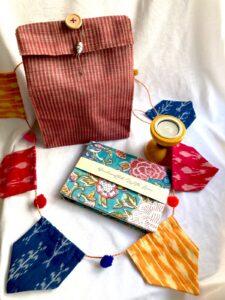
- Gift sustainably. If you haven’t already bought all your gifts, try and see if you can pick up something made of sustainable materials. Most traditional handicrafts are sustainable, and beautiful, to boot! If you’ve already bought your gift, keep this in mind for your next gifting opportunity.
Club Artizen’s Sustainable Festive Box
Tip: Use sustainable packaging. Shiny plastic gift paper, out. Paper wrapping, in.
- Eat sustainably. Check out the mithai ke dabbe. Is there a thin plastic wrap around the sweets? Ask the mithaiwala to do away with that. Pro tip: Sweets individually wrapped in plastic are an absolute no-no.
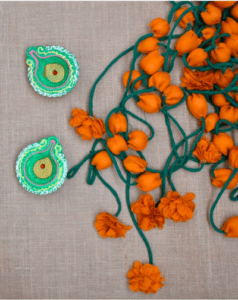
- Decorate sustainably. Tis the season of thorans, flower decorations and much more! The market is full of plastic flowers and synthetic thorans. Minimize the plastic—go for cloth thorans and latkans as a substitute. You can also have children in the house make natural thorans of leaves and flowers—it will also be a fun activity for them.
Cloth latkans look beautiful and can be reused after a gentle wash.
- Wear sustainably. Natural materials like cotton and silk are better for the earth and for your body. When you shop, keep that in mind. This is a tough one, as the most colourful clothes within our budget may not be made of natural materials. Koi na.
- Light sustainably. Buy low-energy consuming LED lights and place strategically for maximum effect. See if you can light oil lamps in some places too. Switch them on only during the night.
LED lights are a great power saver. Pic by Dzenina Lukac
- Use fireworks sustainably. Avoid firecrackers. If you must use them, lower your budget for them and light them responsibly.
- All in all, celebrate sustainably! We often go on autopilot when it comes to festivals, but if you look at everything you do, and make one or two changes every time, that will create a better celebration for all!
What are some of the things you do to make your celebrations more sustainable?
In the past few weeks, it has been a hobby of mine to spot the plastic items in my household. I realize I have become quite nonchalant about what I buy and use, and give no regard to the materials these everyday things are made from. It has to become a conscious choice every time I order something, to know what materials are going into it and how and whether they impact our environment.
Our ancient arts and crafts have been influenced by people, culture and the materials that were easily available in that region. It is no wonder that tribal arts and crafts as well as art forms that date back many years, used the most sustainable and available materials. So here is a list I compiled of what is mostly before us, but what we ignore in favour of cheaper, mass produced, negative impact materials.
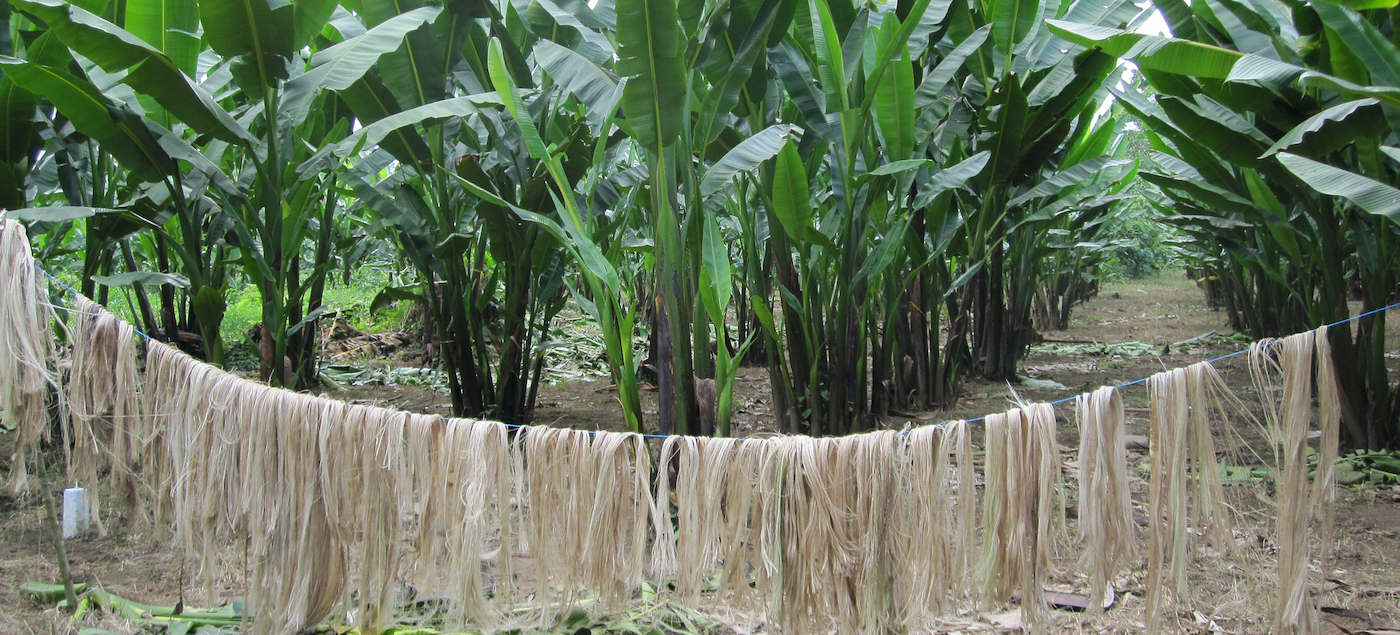
- Banana Fibre
For every tonne of banana produced, four times the waste is generated in farming in the form of leaves, peels, stem etc. Banana fibre emerging from this waste is spun into yarn or even used in handicrafts by artisans making mats, bags and other products. There is every reason for us to adopt banana fibre products – it is wealth from waste, it employs artisans and the more you use these products, the less plastic and other materials you will use, not to mention, the cheaper it will become! Watch out for this fast emerging material in the world of sustainable fashion.
- Coconut Coir
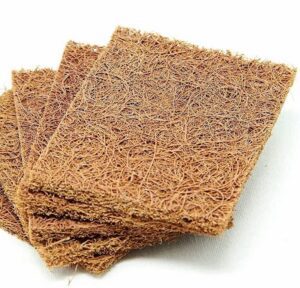
From the outer husk of the coconut emerges coir, a natural and versatile fibre that is used to make a ton of products.
Coir has found uses in ropes, brushes, doormats, rugs and also as insulation. But the most common product that follows me around online these days is the zero waste coir scrub for cleaning utensils.
This was what our grandmothers used, but today, it is a good alternative to the synthetic ones, as coir is a renewable resource and is bio degradable. Surely, it’s time to try it?
- Jute
The National Jute Board in India organizes exhibitions of jute products in various cities and pitches jute to be an alternative to plastic, especially with their range of reusable bags. Jute lunch bags are already popular with office goers, but jute is finding new interest among designers in creating backpacks and other home décor items like placemats and baskets. Spot any jute items in your home?
- Sabai Grass
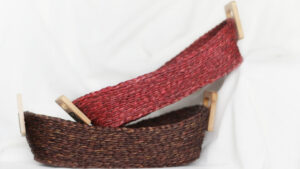
This grass grows extensively in the Eastern States of India.
Sabai grass baskets
Rural women communities cut the grass, bunch them, braid them into ropes and even dye them to create handcrafted products. We have a few of these on our store that you should check out!
The fascinating fact about this material is that sabai grass is believed to be used as military ropes in ancient times! There’s direct testimony to its strength and sturdiness!
- Dried Palm Leaves
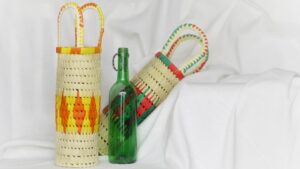
Originating in coastal towns where palms are in abundance, dried palm leaf craft has emerged as the go-to source for baskets, gift boxes, and dried home décor for vases and multiple other products.
Palm leaf bottle holders
Perfect for reuse or safe disposal, this is also used to make nature friendly disposable cutlery, as a great alternative to single-use plastic. Palm leaf weaving employs many rural women and its main market is the wedding industry in the south. The next time you see an eco-friendly gift box at a south Indian wedding, look it up and it’s most likely a dried palm leaf basket. Contact us for bulk orders for eco-friendly wedding gifts and packaging!
Arockiyamary has been coming to the Cluny Art Embroidery Centre for around 40 years. She is the most senior artisan here. Her specialty? She can look at an image and recreate it, in embroidery.
“Including the shading,” adds Sister Augusta of the Sisters of St. Joseph of Cluny, who has been managing the centre for more than 10 years now.
Arockiamary is one of 32 women who come in every morning to work at the Cluny Art Embroidery Centre.
Many of the women come from situations of domestic abuse, and some are widowed and/or separated. Each woman has a story behind her; and they are all tied together by the common thread of the Cluny Centre.
Various designs created by the women artisans of the Cluny Embroidery Centre
The products are varied: embroidered handkerchiefs, napkins, table runners, table cloths, and many more! Sister Augusta shows off sets of napkins with fruits and vegetables as the themes: replete with carrots, broccoli, brinjal, grapes and oranges embroidered on one edge of the napkin.
The magnificent 1774 building where the women work is a delight in itself. The centre is open to visitors, and the products are available for purchase. While the products are mostly picked up by overseas visitors, the centre also receives many local customized orders.
Don’t miss the Cluny Embroidery Centre on your next trip to Pondicherry!



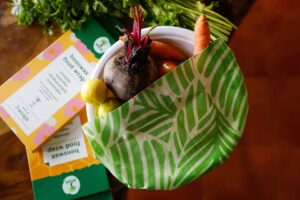 Use beeswax wrap or reusable parchment paper. Beeswax is thicker, so it can withstand heat better than plastic wrap and won’t release harmful chemicals into your food. If you’re interested in making sure that your food stays fresh longer (even if it’s not being heated), try using those steel dabbas for leftovers instead of plastic bags!